TENET ENDING EXPLAINED
Chapter 1.

{Movie title} Ending, Explained.
It began with the twist ending, the kind that so completely flip your understanding of the plot, you have to see the whole movie again. A fad that started in the late ‘90s, and continued, decade over decade. After some number of twist endings though, the idea of that rewatch got less enticing. This gave rise to a new type of specialist, “explainers,” who would sit through the fully-contextualized second and third viewings, and digest the experience into an efficient five minute read. Centralization of effort. We all get more time to devote to our hobbies. “{TITLE} Ending, Explained” became a shorthand: “read this to understand the mechanics of the twist.”
But then, the algorithm got involved, revealing those two words as one of the surest-fire ways to drive traffic from search engines. They became overused. Type “ending, explained” into the search field of a certain kind of high-volume media coverage site — Decider, Screen Rant, etc. — and you’ll get a result for every movie or TV show that ever steered a blip of traffic.
Some of the results may surprise you. Here’s “Drive My Car Ending, Explained.” That’s from Decider, which has a whole Ending Explained series. — “Do you ever get to the end of a movie or show and find yourself asking What. The. Hell?!? You’re not alone.” — OK fine, but Drive My Car, the story of a theater director and his driver helping each other process their grief in modern day Hiroshima, is an odd choice of film to get this treatment.
There’s now a systemic pressure to apply the Ending, Explained mindset to a different kind of story than it was created to clarify. This engenders writing that treats the more “human” story elements — character, theme, you know the ones — as purely mechanical. That is, as something that can be grasped with finality, in the same way the workings of a twist ending can. Every aspect of watching a film is now mental labor that can be offloaded onto someone else, whose completion of the accounting leaves us free to forget the film entirely; it’s solved. Explaining, Ended. Nothing is personal, nothing is private. You’re not alone.
And that’s not even the funny part!

Tenet is a throwback to Nolan’s career-defining Inception. The similarities are clear. International sci-fi epic. Set in a world much like our own, but with a mind-warping technological innovation, and featuring as characters the professionals who have mastered that technology. An air of dread. Nightmare architecture. Labyrinthine plotting. A rare script not featuring Jonathan Nolan’s collaboration and human touch.
The big difference is in the way the two films share information with their audience. Inception is infamously exposition-heavy, handholding viewers through a tutorial, literally, on how to manipulate the dreamworlds of others. And on a personal level, the characters in Inception are independent artisans in a fringe subculture. They need to collaborate to make use of their various skills, and in order to do that, they have to sincerely vibe. They have meaningful relationships; when they keep secrets from each other, it’s a betrayal.
Tenet, meanwhile, features a very different org chart. The film takes its name from a top down organization, a nationless intelligence agency engaged in a secret cold war with a highly advanced future generation. Information in Tenet is hoarded at the top, and no one knows who runs the program. Its members fetishize the need to kill or die to prevent the release of secrets. The protagonist of the film, never named, is a CIA agent who’s recruited into Tenet after he proves willing to take a suicide pill rather than betray his mission. He’s told very little of the conflict he’s being drafted into, “To even know its true nature is to lose,” his handler explains.
And yet, Inception is the more classically “ambiguous” film. Its ending leaves a very specific unresolved question: did the hero ever wake up from his own dream? This goes to show: ambiguity is a construct, and a laborious one. This is especially true if you stick to the more etymologically precise meaning of being open to “either of exactly two” interpretations, Lady-or-the-Tiger-style. If you want to clearly define one narrow area where narrative authority is absent, you have to fill every other space with a bombardment of information.1
Tenet does not operate that way. There is, emphatically, one truth governing the reality of the film. But the film is far less anxious that the audience understands what that is. In his off-center presentation of crucial information, Nolan seems indifferent to the first-time viewer’s ability to come to a functional understanding of the plot.
This is a bit of a wild theory, but I think Nolan’s change in attitude from Inception to Tenet is unlikely to have occurred without the rise of the Ending, Explained. Comfort that the film would eventually be deciphered is what enabled and encouraged a change in Nolan’s sense of obligation to his theatrical audience. Because the conditions that fostered this mutation are new, you would expect a deeply strange film to result. And indeed, Tenet is a movie unlike any other.
Here’s the final irony. “Ending, Explained” are just words that the computer tells us to use, to compete in the marketplace. Their increased use does not correspond to a growing human talent for explaining things, but to the desire, nurtured to a new scale by the internet, to have things explained. There was no team of experts ready to spring into action to service the mysteries of Tenet, a movie finally designed to their skill set. There were numerous obligatory Explainers, but the Explainers all failed.
Don’t take my word for it! Tenet, granted, came out in August 2020, pre-vaccine COVID, when going to the theater was a little dangerous. (On the other hand… what else was there to do.) When the movie finally came to the safety of home-streaming (and rewinding) in May 2021, GQ wrote about it under the headline Tenet Really Explained, For Real This Time: “Naturally, Tenet explainers exist on the internet,” it pled, “but… {they’re} confusing or incomplete.”
And GQ faired no better. But it’s not just that failure to “get” the plot that’s disappointing. It’s the Explainers’ ubiquitous, sour-faced helplessness. The line you saw some version of, again and again, August, May, and onward, was “it hurt my brain.”
We must reverse this damned entropy! The world needs a Tenet explainer that goes the distance, that never begs for mercy.
Tenet, Ending, Explained!
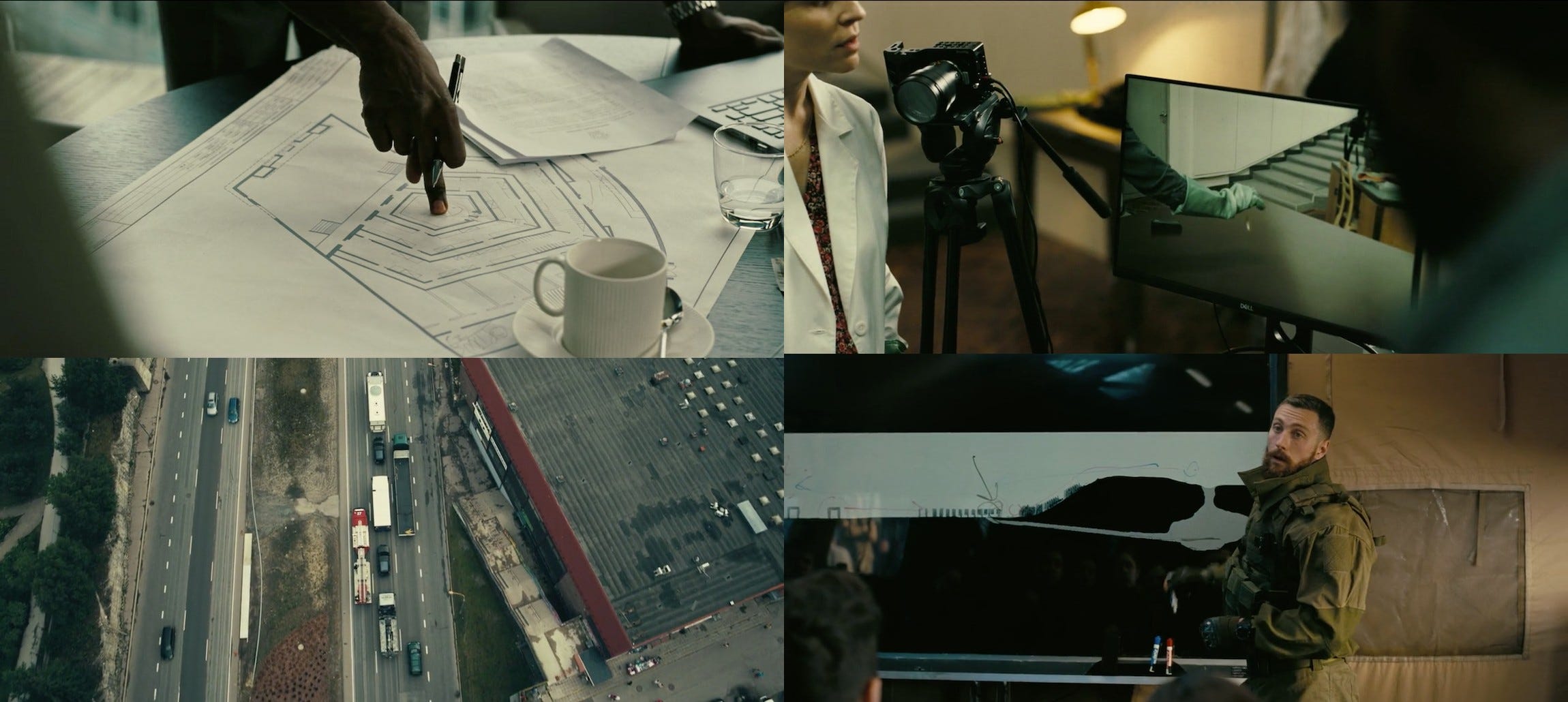
FOUNDATIONAL CONCEPTS
“his movements have the surreal edge of backwards motion” - Tenet shooting script.
People like to say that Christopher Nolan is “obsessed” with time. Fair enough, given how many of his films involve a form of time travel or a ticking clock. But “obsessed” adds an emotional and intellectual component that competes unnecessarily with the more likely truth. In Tenet, reality allows people and objects to become “temporally inverted,” and experience time in reverse, while coexisting in physical space with forward flowing time. “Obsessed” presupposes the existence of an idea that preceded Nolan’s conception of this mechanic, something deeper in him, that necessitated the invention of “temporal inversion” in order to be expressed.
But in interviews, Nolan repeatedly began the creative origin story for Tenet with an image: a bullet being “sucked out of the wall” and back into a gun. He included this shot in Memento, his breakout film, where time running backwards was a metaphor for the protagonist’s amnesia. Since that moment, he “always harbored this desire to create a story in which the characters would have to deal with {time inversion} as a physical reality.” And while he acknowledges his frequent return to the well of temporal tricks, he describes this tendency in strictly functional terms, as a “productive relationship” between the camera and the “physical reality” of time.
If we accept that Nolan builds his narratives around the technical abilities of the camera that he particularly knows how to exploit, a central question of the film becomes clear. It’s a practical one: can “temporal inversion” work as the subject of a narrative film?
Unfortunately, the answer to the question seems to be no.
The thing about temporal inversion is that — while it’s an excellent device for generating cinematic sensory experiences (car crashes in reverse, bullets sucked back into guns, the devil’s music of language spoken backwards) — it’s a terrible device for generating story.
Start with this truism: time travel stories can be split into two basic types. In the first, your actions in the past can alter what happens in the present, as in Back to the Future (1985) and Groundhog’s Day (1993). Nothing is set in stone; have fun and goof around. In the other, there’s only ever one timeline. If you are, at any point in the future, going to go back in time to a moment before the present, then you have already done it. And if your reason for going back in time is to try and change your present, just forget it. Whatever you do will only turn out to be what caused things to be the detestable way that they already are. These stories, like The Terminator (1984 AD) and Oedipus Rex (451 BC), tend to be more tragic, though with an unmistakable black humor.
However, until now, one thing united every story in both of these categories. They’re all about time traveler transporting to a moment in time and space, and, once arrived, moving temporally forward with the rest of reality. Tenet is the only story that I know of which doesn’t follow this “point-insertion” model.2 Tenet’s turnstile does not allow time travel, it inverts your relationship to time. When you exit the machine, temporally inverted, the rest of reality appears to you to be moving backward in time as you move forward. You travel backwards through time until such point as you can reach another turnstile and de-invert yourself. Because all along this journey you are physically interacting with the world, there’s no “point of insertion.” Rather, there’s an infinite series of points. You’re a persistently arriving time traveler.
This change in mechanics destabilizes both story models. Back to the Future would seem to be right out. In that framework, the timeline is reset by whatever your final action is in your “most recent” trip to the past. But if you are persistently arriving, you are constantly creating — and immediately erasing — new timelines. By the time you de-invert yourself, you’ve erased every new timeline that your interactions have caused, before you can experience them.
But if you instead adopt the “one timeline that loops back into itself” model, you still have a problem. In the single-point-insertion version of that story, these loops of causality — there was one in Nolan’s Interstellar as well — only have to connect to each other once. But the persistently-arriving time-travelers of Tenet have to generate loops at every moment of interaction in an endless string. Every segment of time during which the two timelines are interacting must be a causal loop. Not only must there be a paradoxical time loop from 1pm - 3pm, but also from 2pm - 4pm. The story problems this creates are exponentially more difficult to resolve — beyond the achievement of the human mind and all known methods of computing.
But on the other hand… what if you really, really, really want to make it work? I mean, weigh them against each other. Impossible narrative problems in one hand. Reverse explosions sucked back into jet engines in the other. You know what you have to do.
Nolan uses every calorie of brute force he can muster to wring a story out of this concept. To do so, he creates an arsenal of work-arounds to deal with the “infinite-paradoxes” problem. Whether or not they are enough is a matter of personal judgment. Anyway here they are.
“Entropic wind”
So, if there’s backwards and forwards spies shooting guns at each other, and every inverted bullet makes a bullet-hole that travels into the past, why can’t we see all the bullet-holes that have yet to happen? Because the “entropic wind” is currently flowing in our direction. Forward-flowing time dominates reverse-flowing time. So, if you fire an inverted bullet into the wall, the bullet hole will travel a few minutes backwards in time, but then the tidying force of our entropic wind will smooth it out.
“Posterity”
Posterity is the name for the Tenet organization’s armed forces. They’re the ones who engage in gun battles with the evil forces from the future across the timeline. They also clean up after these battles, so that the public never finds out about time travel.
“Whatever happened, happened.”
If you’re telling the story of a causal loop that is decades long, you have it pretty easy. How is a killer robot supposed to know that by hunting the mother of humanity’s future resistance leader, he’s creating the sexual tension that will cause that leader to be conceived? These misunderstandings and coincidences are not that difficult to stage manage. But the causal loops of Tenet are sometimes only minutes long, and this leads to problems. The loop’s participants understand the entire context of the loop they’re enacting. And so they will often consciously participate in a causal loop, by “doing the thing they know they did.”
“Don’t try to understand it. Feel it.”
This is the big one. Right after the nameless hero of the film (played by John David Washington) is recruited, he’s sent for a cryptic debriefing at a Tenet lab, where a scientist introduces him to the concept of inversion, by letting him see the evidence room full of time-inverted debris. She uses an inverted bullet as a teaching tool. Inverted bullets appear identical to regular bullets, but can be interacted with in a different way. You can cause them to jump back into your hand, which will look spooky to your eye — as if it were dropped, but the action played in reverse. She even films the action, and plays it back in rewind.
She tries to teach him how to “un-drop” a bullet. At first, he can’t make it happen. “You have to ‘have dropped’ it,” she explains, which is shockingly all the advice he needs to be able to perform this miracle on his own. He has a million questions, which she brushes off. “Don’t try and understand it. Feel it.”
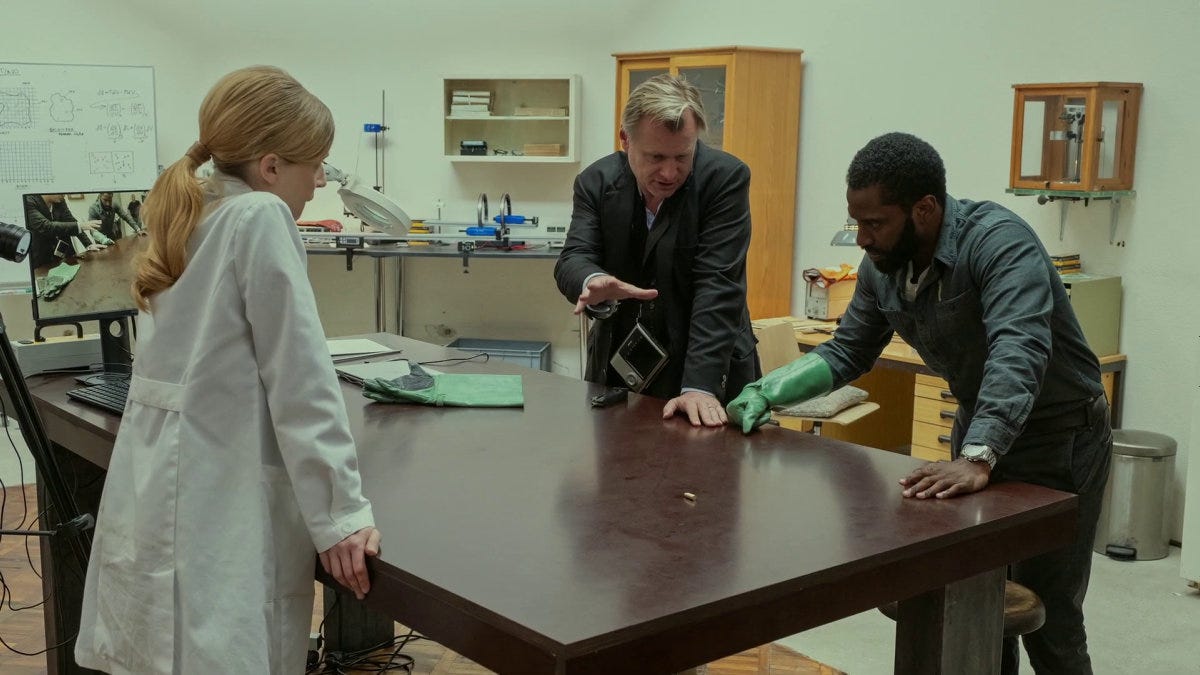
Understandably, to many this line sounded like one giant cop-out, a confession that the movie has no underpinning logic. But she’s actually describing a very specific element of the mechanics of time travel as they’re presented in the film.
You can cause a bullet to “un-drop” if you decide to “have dropped it” a few seconds in the future. “What about free will?” he asks. This may seem like a non sequitur, but if you have pre-decided to drop a bullet, and the bullet has begun the action of falling in reverse, then for the duration of its unfalling, you can’t “change your mind.” The scientist’s answer is that, he still has free will, since he’s still the one who chose to drop the bullet. And while this is true, he clearly has free will differently than he thought he had it. He has enough free will to make decisions that cover blocks of time, but not does not have it continuously, moment-to-moment. Transactionally, his free will now has the power to travel through time and generate otherwise impossible loops of cause and effect. “Don’t try and understand it” applies only to this one bit of magic that is necessary to make the story engine hum to life.
Even narrowed in scope, “just feel it” may still seem like cheating. But, there’s nothing new about cheating. Especially in this sub-genre of “causal loop” time travel stories.
There’s a sort of person, baffled and frustrated by a made-up story where events loop back and cause themselves to happen, who insists on asking the Question of Death: “But how did it happen the first time?” These people are annoying and we should eat them instead of cows. But, they have a point. Where does any causal loop “come from”?
Sophocles’ answer to this was “fate.” In Oedipus Rex, his re-dramatization of a familiar myth, Oedipus learns from an oracle that his fate is to kill his father and marry his mother, so he leaves town. But, Oedipus doesn’t know that he’s adopted; he meets his biological father as a stranger on the road, terminates him, and marries his wife.
Oedipus cannot escape his fate, and today’s readers tend to say that Oedipus Rex is “about” fate. This introduces a similar confusion as saying Nolan is “obsessed” with time. It suggests that the mechanic of prophesy was invented to embody the theme of fate. I’m not a classicist. It’s only instinct that leads me to insist that this is backwards. Prophesy came first. Being cursed is cool, a cool thing for a play. But it doesn’t make sense. If you’re cursed to do something terrible, couldn’t you just, stay in bed, not do the thing? Well, no, because “Like sleuth-hounds, the Fates pursue.” The ancient Greeks had their own plot cheats. But by subsequently making fate the theme of the play, Sophocles created harmony. He cheated with honor (as understood by men of his profession).
Likewise, Nolan cheats with honor. He weaves the mechanical work-arounds he comes up with into the fabric of the story. Entropic wind is the MacGuffin — the forces from the future are trying to reverse its direction, annihilating the past. “Whatever happened, happened” is wisdom that the hero resists, but learns at great cost.
The advice to “just feel it,” is central to what Tenet is “about.” The power Sophocles gives to the gods, Nolan gives to humans. His causal loops are authored by human will, projected into reality through some force whose method is incomprehensible, but unmistakable. Nolan doesn’t give his main character a name, but on the page (and in the credits) he gives him a title: The Protagonist.3 The Protagonist, I would aver, is the person whose will manifests the loop. This idea echoes across the script. The Protagonist, debating with one of the more ruthless members of Tenet, refers to himself as “the protagonist of this operation.” She insists that he is merely “a protagonist.” He disagrees with her, and later proves it. "I'm The Protagonist" is his last line of dialogue.
Understanding that theme is often reverse-engineered to create unity with the more immediate mechanical needs of the plot, and not an emanation of the author’s obsessions (or even their true beliefs), can be disenchanting. But it’s important to also remember that “the needs of the plot” connect back, at some point, to reality. “Can time inversion work as a story” is a question with empirical value.
And so what seem like cheats are actually discoveries.
COMING IN PART TWO: Talinn! Oslo! Stalsk-12!
For example, look at the reaction to the morally ambiguous ending of the video game The Last of Us. The S-P-O-I-L-E-R intention is to ask the audience to consider whether it would be worth it to sacrifice a friend’s life for the cure to a civilization-ending disease. But because the story chooses “realism” and refuses to narratively 100% guarantee that the cure would work, the most popular audience response to the question slips the intended binary: “I’d save my friend because the cure would not even work.” So it goes.
Even Primer, which also posited a version of time travel that took a day to travel back in time a day, forced its travelers to spend the journey backwards locked inside the machine, and they can only leave the machine at a preset destination.
Every Tenet explainer hast to come to terms with what to call The Protagonist in print. Some call him TP, others are too shy and refer to him by his performer’s name. I’m just going to call him The Protagonist.
Read your article on "Killers of the Flower Moon" and its antecedents in Hollywood. Did you know the movie was first made in 1926? "Tragedies of the Osage Hills" was a feature by Nanticoke Indian filmmaker James Young Deer about the Osage murders. See interview with me: https://osagenews.org/ucla-lecturer-digs-deeper-on-hollywoods-long-lost-reign-of-terror-films/